Case Study / E-commerce
ASYADROP: streetwear online store
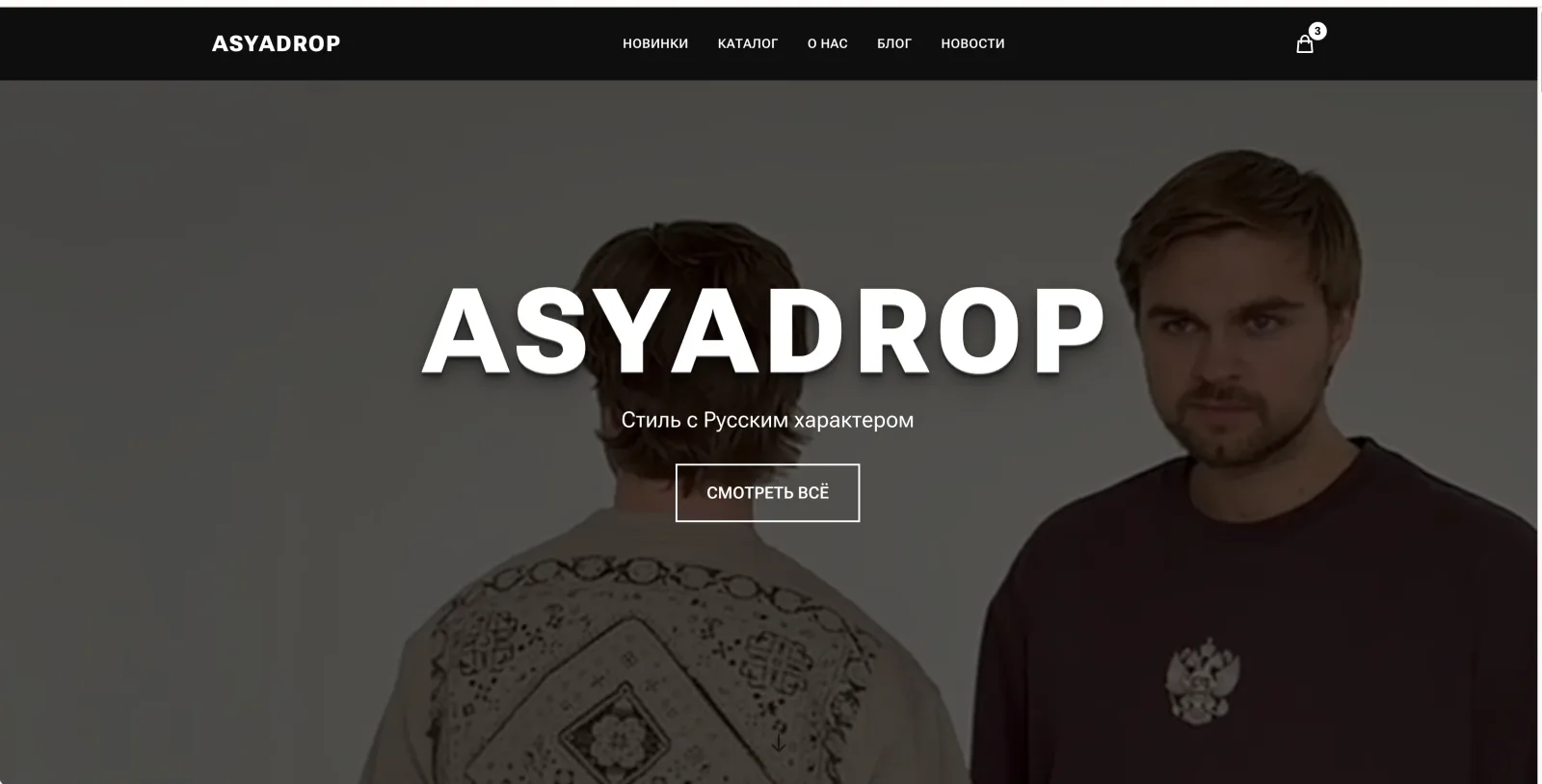
ASYADROP sells limited streetwear drops. I built this online store solo as a fullstack developer: a storefront on Nuxt 3, a backend on Strapi 5, payments compliant with Federal Law 54-FZ, and CDEK delivery. The store is live in production, taking real orders.
- Type
- Streetwear online store
- Stack
- Nuxt 3, Vue 3, Strapi 5
- Role
- Fullstack, solo, turnkey
- Payments
- Tochka Bank online acquiring, fiscal receipts under 54-FZ
- Delivery
- CDEK, pickup point selection on map
- Traffic
- ~10,600 visitors/month
About the project
ASYADROP is a Russian streetwear brand that releases limited drops. They came to me needing a store where they could showcase a new collection and start taking orders right away. I took on the whole thing: frontend, backend, payments, delivery, deployment. One person from mockup to production server, no agency, no chain of middlemen.
Storefront, catalog, and cart
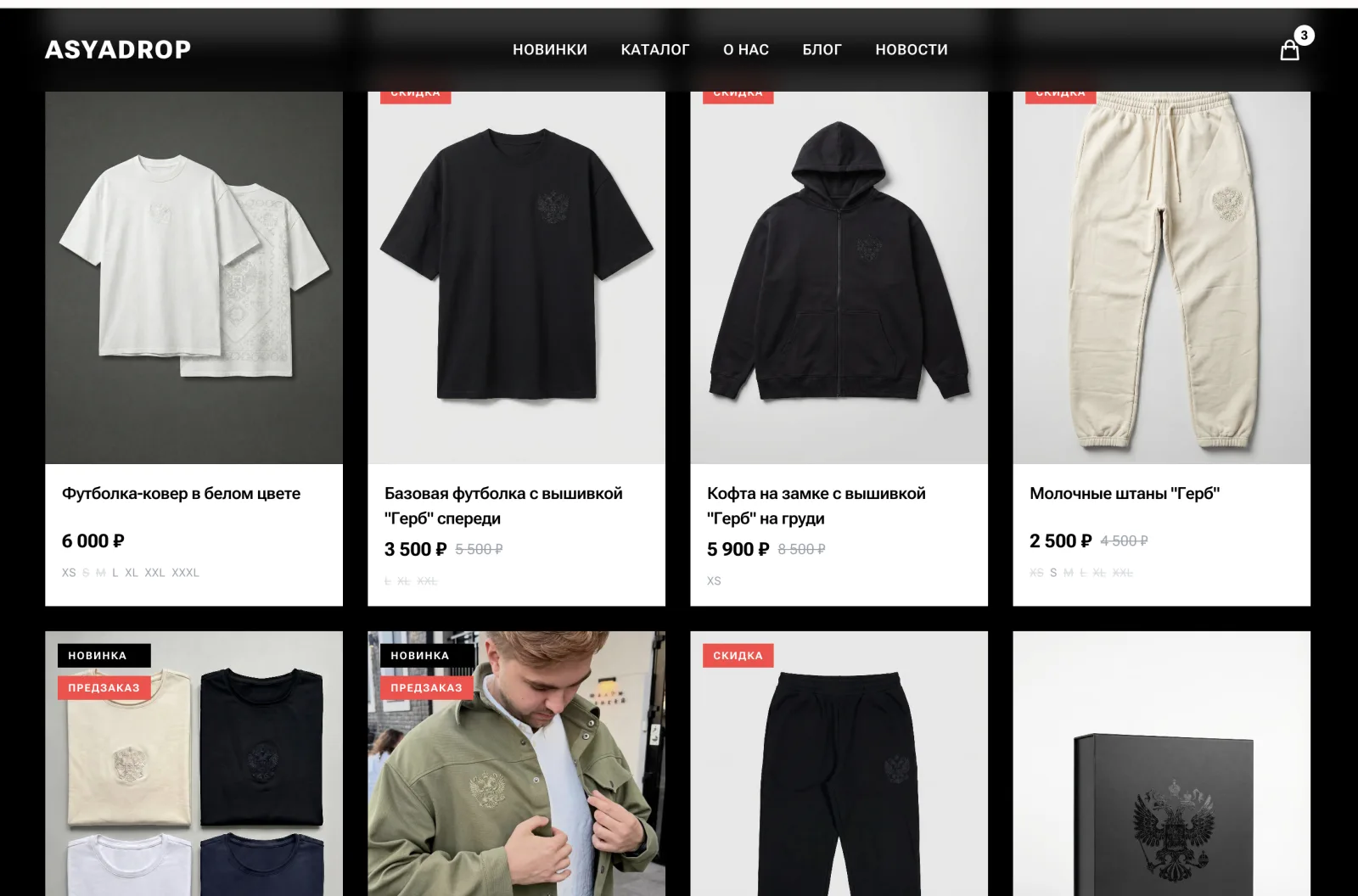
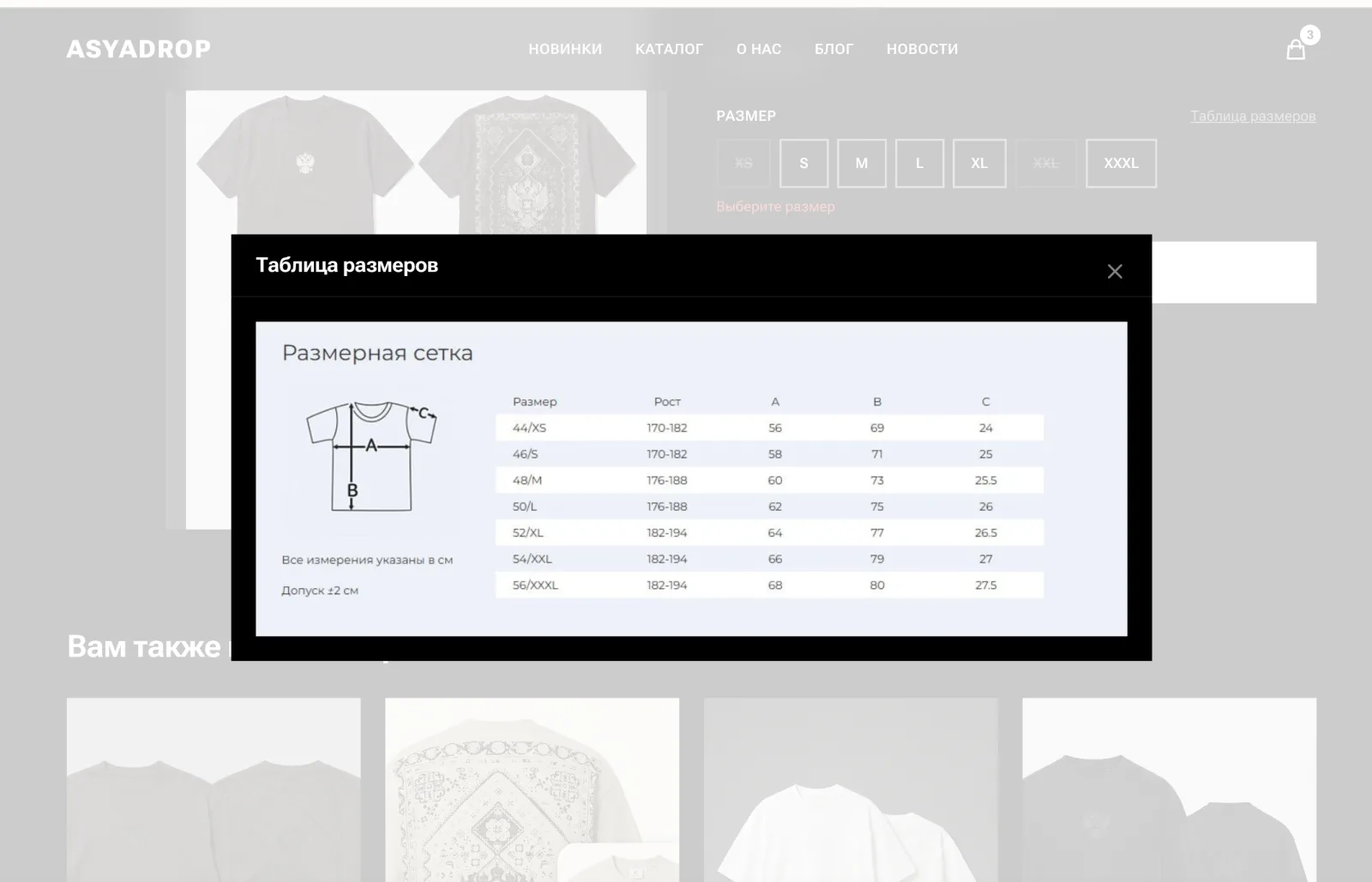
I built the storefront and drop catalog on Nuxt 3. Each product card handles variants: sizes, stock availability, and discounted prices via promo codes. The cart lives in Pinia and survives a page reload. From there it's a short checkout flow: contact details, delivery, payment. I kept the path to order as short as possible, because during a drop sale every extra screen eats into conversion.
Payments and delivery
Payments run through Tochka Bank's online acquiring. A fiscal receipt goes to the buyer by email automatically, fiscalized under Federal Law 54-FZ, no separate cash register or OFD contract needed. Delivery is handled by the CDEK integration: the buyer picks a pickup point on the map, the order gets a tracking number, and statuses update automatically. An email notification fires at every step via nodemailer.
Results
The store is live and handling real load. Yandex Metrica shows around 10,600 visitors in a month, and traffic has roughly doubled. To be straight about the source: most people come from the brand's social channels, not from search. Organic traffic is modest, around 690 sessions a month. So this is a case study about a working e-commerce store with live orders, not about ranking at the top of search results. I'm not sharing revenue or conversion numbers since that's the client's data.
Why this stack
Strapi 5 as a headless CMS gave the client a comfortable admin panel: they can update products, drops, and promo codes without me. The database is SQLite, because the catalog is compact and it's simpler to run everything on a single VPS. Nuxt's SSR and a dynamic sitemap keep every page crawlable for future indexing, even while most traffic still comes from social media.
Project stack
- Nuxt 3
- Vue 3
- Pinia
- Tailwind CSS
- Nuxt Image
- Strapi 5
- SQLite
- Tochka Bank (online acquiring)
- 54-FZ
- CDEK
- nodemailer
- VPS
Questions about online store development
How long does it take to build a turnkey online store?
It depends. A storefront with a cart and payment can be put together in a few weeks. ASYADROP took longer: it had a drop catalog, online acquiring with Federal Law 54-FZ compliance, and CDEK shipping, plus I had to fine-tune the checkout and promo code logic to fit the brand. I give a real timeline after the brief. The number of products, the integrations you need, and the design account for almost everything.
How does payment and the online cash register under Federal Law 54-FZ work?
For ASYADROP I connected payments through Tochka Bank's online acquiring. The fiscal receipt goes to the buyer automatically, with fiscalization under Federal Law 54-FZ, no separate cash register needed and no direct OFD contract. The bank handles the online cash register requirement itself. It's not the right fit for everyone: some clients already have their own cash register or OFD setup. In that case, I connect whatever's already in place.
What delivery integrations are available, CDEK and others?
The store has a CDEK integration: the buyer picks a pickup point on a map, the order gets a tracking number, and statuses update on their own. An email notification fires at every step via nodemailer. Adding other carriers or courier delivery is doable. CDEK was the brand's choice here. I connect whichever logistics provider you're actually using to ship orders.
Who owns the store and the code after handoff?
Everything is yours. After handoff, the code, the database, and all credentials transfer to the client, with no lock-in to me or any closed platform. ASYADROP runs on its own VPS, and the owner manages products and promo codes through the admin panel themselves. I don't hold the project hostage with a subscription. If you ever want to hand it off to another developer, everything is open and documented.
Why is a custom store better than Tilda or an off-the-shelf solution?
Builders like Tilda are fast to launch and cheap while their templates do the job. Hit the limit, and you're fighting the platform. A custom store built on Nuxt gives you full control: your own checkout, your own drop and promo code logic, your own performance. For ASYADROP that mattered: a limited-collection drop can't afford extra friction in the flow. A small storefront with five products is fine on a builder.
Will there be an admin panel so I can manage the store myself?
Yes. In ASYADROP, Strapi 5 serves as the headless CMS: the client manages products, drops, promo codes, and stock themselves, no developer involvement and no code required. The interface is straightforward and takes almost no training. That part is non-negotiable for me. The store shouldn't depend on a developer every time a new collection drops.
Can the store be integrated with 1C later on?
It can. The store exposes structured data on products and orders that can be synced with 1C, a warehouse system, or a CRM. ASYADROP didn't need that: the catalog is compact and the owner was fine managing everything through the Strapi admin panel. I add 1C sync when a business already has accounting running and needs stock and order data to stay in step. Built around the actual process, not just to tick a box.