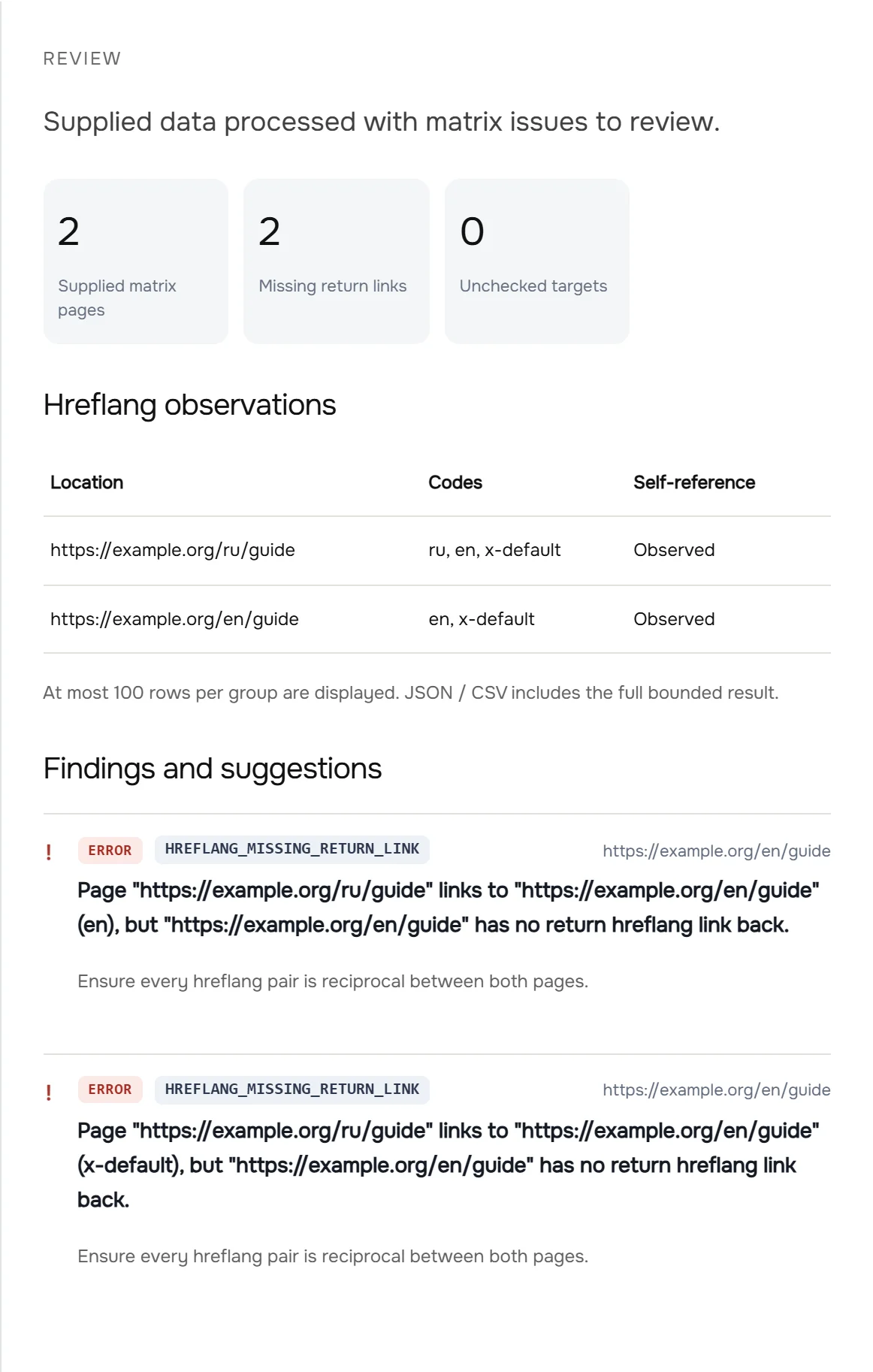
Check the return declaration on the target page
Compare the alternate declarations in both language versions. If the English page is missing its return declaration for the Russian page, add that declaration in the HTML or CMS output and capture the same group again.
Here we reproduce the check using two synthetic JSON records in the hreflang checker. The experiment changes the supplied data; no live example.org page was edited or crawled.
Google’s localized versions guidance calls for self-references and reciprocal language alternatives using full URLs. x-default is an optional fallback.
What the input was missing
The example uses two synthetic page records: https://example.org/ru/guide and https://example.org/en/guide. The pages are described as self-canonical in the example, and that canonical setup does not need to change to repair hreflang.
The key defect is simple: the Russian page already declares ru, en, and x-default; the English page declares en and x-default but lacks the reciprocal ru source entry. That creates the missing return-link condition.
| Item | Before | After |
|---|---|---|
| Pages | 2 | 2 |
| Declarations | 5 | 6 |
| Reported missing returns | 2 | 0 |
| Unchecked return links | 0 | 0 |
Two reported return-link observations do not mean two separate defects. In this case, both point to one missing Russian-language return declaration on the English page, and the two observations come from the same shared target.
The exact declaration that must appear on the English page head is:
<link rel="alternate" hreflang="ru" href="https://example.org/ru/guide">
Do not change canonical targets as part of this hreflang fix. In this example both pages remain self-canonical. See the canonical audit example for the separate target-selection task.
Before audit: what the checker reported
- Download the before inventory and copy its JSON into Before XML sitemap or hreflang JSON.
- Leave After XML sitemap (optional; leave blank for JSON) empty.
- Select Inspect supplied data, then Download JSON.
- Repeat with the after inventory in the same first field. The second field accepts an XML comparison, not a second JSON matrix.
Saved files for the example:
The actual published tool produced the before result with two missing return links, no missing self-links, no unchecked return links, and two errors. Those numbers describe the supplied data set only; they do not measure HTTP, rendered language, indexing, or selected canonical status.
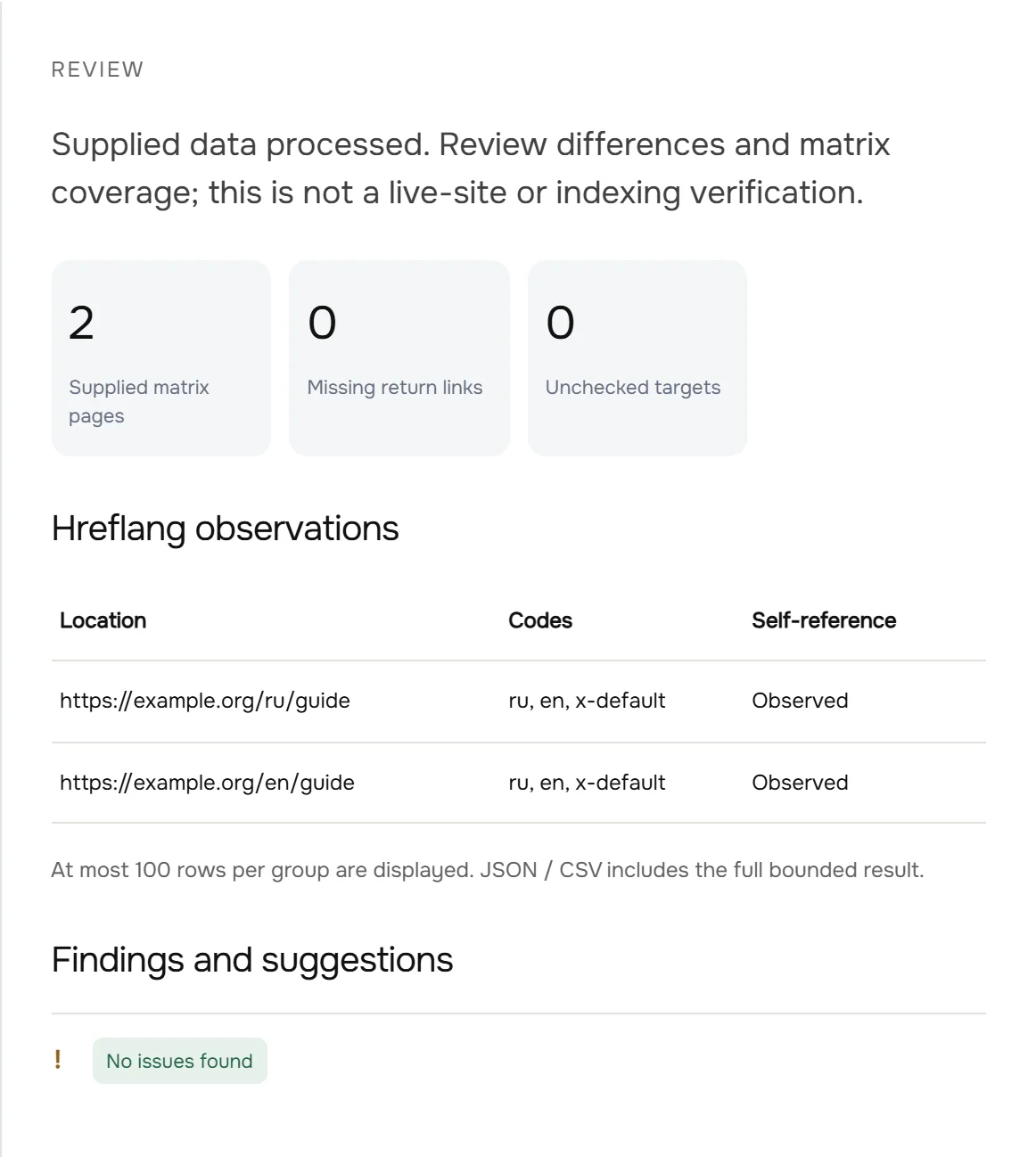
Rerun the corrected JSON example
The after JSON demo shows the same two-page set with one added declaration, one more alternate in total, and no remaining missing return links or errors. This is the verified comparison for the example, not a claim that any live site was edited or recaptured.
On a real site, edit the HTML or CMS source first, then export fresh data from the same page group and rerun the checker. Changing only the JSON demonstrates the audit and does not fix a live website.
The important distinction is that canonical and hreflang solve different tasks. Keep canonical decisions separate from hreflang decisions; the example pages remain self-canonical, and hreflang should not be “fixed” by changing canonicals.
Why the control stays partial
The control case removes the English record from the input. The checker then sees one supplied page with two unchecked references, zero missing return-link findings, and a partial status. That is not a fixed site; it is incomplete data.
Both unchecked references point to the same absent English target. Zero errors in a partial control does not prove correctness. It only means the checker could not verify the missing targets from the supplied data.
Production checklist and useful questions
Use this checklist on a real project:
- Edit the real head or CMS output, not only the audit file.
- Include both the self-reference and the reciprocal alternates in each language version.
- Keep canonical and hreflang changes separate.
- Capture fresh markup from the same page group after the source change.
- Verify the source response separately, because the JSON tool does not fetch pages or prove indexing.
- If the input is partial, check the sample limit before treating the result as a site-wide verdict.
Useful questions:
- Which page is missing the reciprocal source declaration?
- Is the problem in live markup, or only in the audit input?
For context, use the parent checker and the canonical guide together with the methodology notes when you need a separate comparison of hreflang and canonical tasks.
Need help with your website?
Development and SEO services →