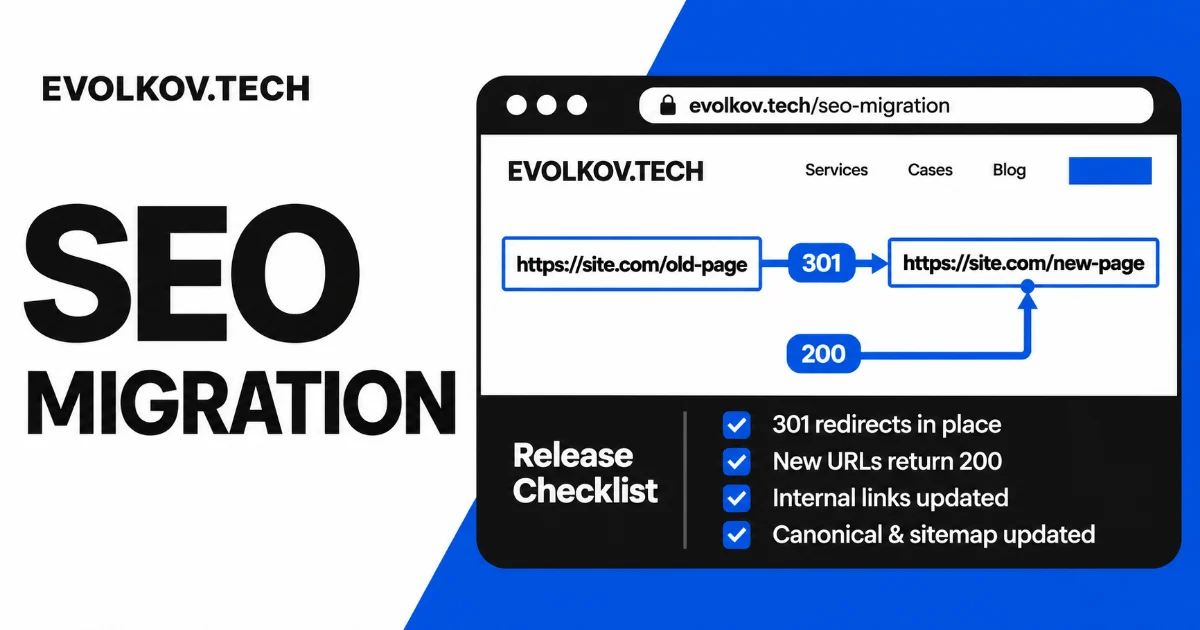
If you are buying SEO migration support, define the work as a controlled change to URLs, templates, redirects, and search signals, not as a vague promise to keep traffic unchanged.
Use this short checklist before you agree to the scope:
- Confirm whether the move is a permanent URL change or only a hosting/platform move.
- Agree the URL map, including justified exceptions.
- List the deliverables, the owner for each deliverable, and the acceptance rule.
- Record who changes DNS, redirects, CDN, CMS, templates, and analytics access.
- Require a dated baseline, a release owner, and a post-launch recheck window.
The practical goal is simple: everyone knows what will be changed, who will change it, what evidence will be captured, and what counts as accepted work.
For broader technical context, this service sits under the main technical SEO offering: technical SEO service. For the step-by-step operational checklist, see website migration SEO checklist.
What the service includes, and what it does not
SEO migration services should be scoped around implementation and verification. The service can cover planning, redirect design, technical coordination, and release checks. It should not be sold as a blanket guarantee that rankings, crawl demand, or traffic will behave in a fixed way after launch.
A useful way to define scope is to separate the migration type:
- Permanent URL move: old URLs are replaced with new URLs and should be mapped with permanent redirects.
- Hosting or infrastructure move without URL change: the site stays on the same URL structure, but the server, CDN, deployment, or platform layer changes.
These two cases overlap, but they are not the same. A permanent move requires URL mapping and redirect control. A same-URL hosting move requires release coordination, status-code checks, and signal consistency, but the risk profile is different.
Platform also matters. A WordPress move often centers on plugins, server rules, templates, media paths, and sitemap generation. A Vue, Astro, or custom build may rely more on routing rules, prerendering or rendering behavior, and deployment configuration. The service should say which layer will be edited, by whom, and which layer is out of scope.
| Scope item | Within scope | Outside scope | Must agree before work |
|---|---|---|---|
| URL mapping | Old URL to new URL mapping, exceptions, redirect target logic | Search engine ranking promises | Yes |
| Redirect implementation | Permanent redirect rules, testing, correction of broken targets | Fixing unrelated product bugs | Yes |
| Template and CMS changes | Technical changes tied to migration | Full redesign not related to migration | Yes |
| Search signal checks | Canonicals, hreflang, internal links, sitemap references | Rewriting all content from scratch | Yes |
| Post-launch monitoring | Fresh production recheck and ownership of follow-up items | Unlimited recovery work without boundaries | Yes |
For methodology details on how verification is structured, see Reproleaf methodology.
Google’s site move guidance explains address mapping and post-launch monitoring. Choose the redirect type to match the intended move, following the redirect guidance.
Deliverables the client can review before release
The buyer should receive deliverables that are easy to inspect, version, and accept. For a migration project, the deliverable is not only the change itself. It is the evidence package that shows what was planned, what was changed, and what was observed.
| Deliverable | Format | Owner | Acceptance rule |
|---|---|---|---|
| URL map | Spreadsheet or JSON | SEO / developer | Matches agreed source and destination set, with exceptions documented |
| Redirect plan | Rules file, server config, or implementation notes | Developer / infra | Old URLs resolve to intended final destinations |
| Baseline snapshot | Timestamped inventory or crawl export | SEO | Date and coverage are explicit and reproducible |
| Release checklist | Markdown or checklist document | Project owner | Has owners, timing, and sign-off fields |
| Verification report | JSON or comparable trace record | SEO / QA | Shows observed response chain, final status, and exception list |
Good deliverables are precise. They state the source environment, the coverage limits, and the acceptance criteria. They do not hide behind a single screenshot or a loose verbal update.
For implementation follow-through after the audit phase, see implement SEO audit fixes.
Who owns which part of the migration
Unclear ownership can leave migration tasks unassigned or unchecked. The service should define responsibility for each action without assuming the client has the same internal structure as another project.
| Work area | SEO | Developer | Infra / hosting | Site owner |
|---|---|---|---|---|
| URL mapping and exceptions | Proposes and validates | Implements when needed | Usually not primary | Approves business exceptions |
| Redirect rules | Reviews intent and coverage | Builds or edits rules | May assist at server level | Confirms release window |
| DNS and domain settings | Checks impact | Usually not primary | Changes if assigned | Owns access and final authority |
| CMS, templates, routing | Checks SEO impact | Implements | Supports deployment | Approves content and product constraints |
| Monitoring after launch | Defines checks and interpretation | Fixes defects | Supports server issues | Owns business decision on continued rollout |
This is a proposed responsibility model, not a universal contract. In some teams, the same person may cover multiple rows. In others, the service provider only advises while the client executes.
In the initial enquiry, the fastest useful inputs are the URL, platform, migration scope, purpose, timing, planned changes, and preferred access method. Do not send passwords or tokens in the first message. Use a secure process once the working agreement is in place.
How to review a contractor’s evidence
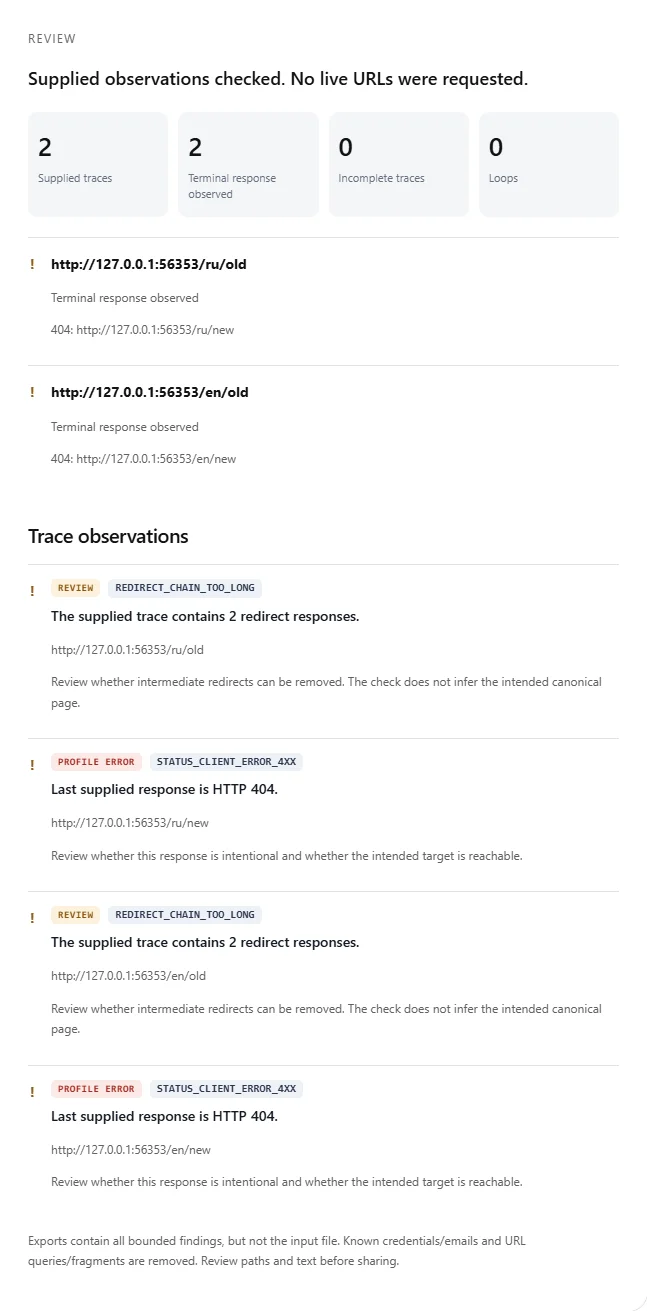
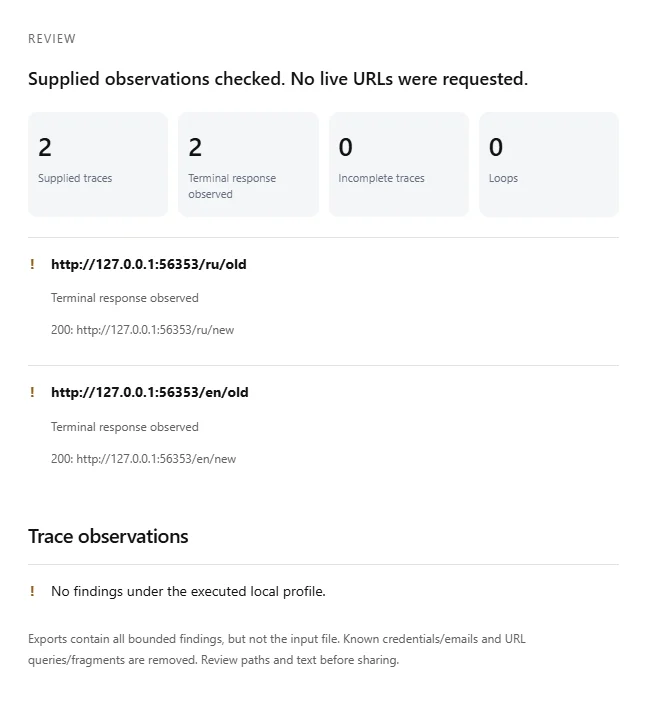
The example comes from the website migration checklist. It reuses an actual local HTTP fixture, not a customer case. Two RU/EN GET traces initially passed through an intermediate redirect and ended at 404. After the change, each used one permanent redirect to a 200 response.
| Observation | Before | After |
|---|---|---|
| Terminal traces | 2 | 2 |
| Redirect chains | 2 | 0 |
| Broken targets | 2 | 0 |
The Reproleaf redirect checker inspects the retained JSON without making network requests in this mode. The local server has stopped; the 127.0.0.1 addresses in the files preserve the observations’ origin. These traces do not establish indexing, traffic preservation or form correctness.
How acceptance should be defined
Acceptance should be written before release. The cleanest rule is to accept the migration only when the agreed evidence package matches the agreed scope, including the URL map, status codes, redirect chain, and follow-up ownership.
Acceptance should include the after-release trace, not just the implementation note. In the example fixture, the after-state shows two traces, zero errors, zero warnings, zero chains, zero broken targets, and two terminal traces. That is a useful technical result, but it still does not prove indexing, organic recovery, or content equivalence beyond the observed request path.
Acceptance should also require a fresh production recheck after release, with named ownership for any recovered issues. The release is not complete when the change is deployed; it is complete when the post-launch checks have been run and the remaining follow-up has been assigned.
For a concise operational checklist, see website migration SEO checklist.
The control example has errors = 0, incompleteTraces = 2 and terminalTraces = 0. Only the first hop of each trace was retained, leaving the terminal response unknown. A zero error count cannot make that incomplete capture an accepted migration check.
Use the SEO implementation workflow for code fixes and the Reproleaf methodology to interpret input coverage.
What determines the migration quote
A real estimate depends on the structure of the change, not on a generic hourly guess. The same migration scope can be small in one environment and complex in another.
Estimate the work by these variables:
- Template count: more templates usually means more places to check links, canonicals, and rendering behavior.
- URL families: product pages, articles, category pages, localized pages, and legacy archives may each need different rules.
- Routing and CDN complexity: proxy layers, rewrites, and edge rules can change how redirects behave.
- Locales: multilingual sites need separate URL, sitemap, and hreflang review.
- Data quality: incomplete inventories create reconciliation work.
- Access readiness: if logs, CMS, deployment, and analytics access are delayed, the schedule becomes less predictable.
- Forms and transactional areas: checkout, lead forms, and account areas require separate caution.
- Unknowns: any undocumented legacy rule, exception, or plugin adds review time.
A buyer should ask for an estimate structure, not a fake precision number. A useful proposal explains what will be reviewed first, which assumptions are required, what evidence will be produced, and which tasks become separate work if the scope expands.
The quote should compare like with like. If one proposal includes URL mapping, implementation, verification, and release support, while another only includes an audit, the lower number is not automatically better. It may simply omit responsibility.
What should be in the release package
The release package is where scope becomes operational. It should contain the documents and checks needed to move from planning to execution and then to recheck.
Include these items once, clearly, and in a form the team can actually use:
- JSON examples: one each for the before inventory, before report, after inventory, and after report.
- Markdown release pack: scope, RACI, and checklist in one place for the team.
- CSV or spreadsheet exports: if the team needs them for manual review.
Release conditions should also include concrete operational clauses:
- A dated baseline captured before changes begin.
- A URL map with justified exceptions recorded in writing.
- Captured old status, new status, redirect Location, and final destination.
- Source environment and coverage stated explicitly.
- Canonical, hreflang, internal link, and sitemap checks kept separate from redirect checks.
- A restore plan that was actually tested, not just downloaded as a backup file.
- A release owner, time zone, and contact path for the launch window.
- Recovery limits for new transactions or new data created during the change window.
- A fresh production recheck with ownership of monitoring and follow-up.
These conditions are especially important when the site changes platform. A WordPress move may require different release steps from a Vue, Astro, or custom build because the implementation surface is different even when the business goal is the same.
Download the scope and acceptance template
FAQ
Who owns DNS during a migration?
The site owner should own domain and DNS authority, even if a developer or infra specialist executes the change. The service scope should say who is allowed to make the change and who approves it.
How is a WordPress migration different from another platform?
WordPress often involves plugins, server rules, templates, and sitemap generation. Other platforms may rely more on build routing, deployment rules, or rendering logic. The service should list the relevant layer rather than assume one universal workflow.
Why does one quote look higher than another?
Because one proposal may include mapping, implementation, verification, and release support, while another only covers analysis. Compare the deliverables, the owner coverage, the evidence package, and the post-release responsibility before judging cost.
When is a 200 response not enough?
When you need proof of more than a reachable URL. A 200 response does not prove indexing, content parity, canonical correctness, hreflang correctness, or form behavior. It is necessary evidence, not complete evidence.
What post-launch support is reasonable?
A reasonable support definition covers a fresh production recheck, issue triage, and ownership of the agreed follow-up items. It should not imply unlimited recovery without boundaries.
Can a migration provider guarantee unchanged rankings and traffic?
Avoid promising fixed rankings, fixed traffic, or zero-loss outcomes. Migration work can be well executed, but search systems can still fluctuate after significant site changes.
Next step: how to request a migration proposal
If you are ready to request a proposal, send a short brief with the minimum useful facts: the URL, platform, scope, purpose, timing, planned changes, and the access method. If you already have a crawl, inventory, or staging notes, mention that too.
The strongest brief also says what will not change. That helps the provider distinguish a permanent URL move from a same-URL hosting move, and it helps define which checks belong in scope. If the project touches redirect logic, templates, locale paths, or release ownership, say so explicitly.
When evaluating a proposal, look for four things: clear responsibility, clear deliverables, clear evidence, and clear acceptance. If those are missing, the quote is not ready yet, even if the price looks attractive.
For the full operational sequence, use the checklist article, then confirm the implementation workflow with the audit-fix guide and the service page. That sequence keeps planning, execution, and verification aligned instead of mixing them together.
Helpful references: migration checklist, implementation guide, and technical SEO service.
Need help with your website?
Development and SEO services →