- Work from the confirmed finding and its reproduction notes.
- Fix the source pattern, not each output page by hand.
- Keep unknowns explicit and ask for clarification when data is missing.
- Accept the change only after a scoped recheck of the same condition.
Triage the finding before you touch code
The first implementation step is triage. Decide whether the finding is a single-page defect, a template-level defect, or a generator-level defect. For SEO work, that distinction matters because one code path can affect many outputs. A practical triage note should answer four questions: what was observed, which pages or templates share the cause, what is still unknown, and whether the next action is implementation or clarification.
Use the validated finding as a source of truth, but do not assume every adjacent issue belongs in the same ticket. If the report is missing the exact scope, a repeat condition, or the affected template, ask for clarification first. If the evidence is complete, move to implementation. For title-link topics, Google recommends concise, descriptive title text and notes that displayed title links can be selected from multiple signals. That is useful context, but it does not prove what search will display after your code change.
Related references for the working process are the acceptance guide, the service overview, the duplicate-title audit example for grouping logic, and the Reproleaf methodology for repeatable local analysis: SEO audit deliverables, technical SEO service, duplicate title tags audit, and Reproleaf methodology.
Google recommends descriptive titles and avoiding repeated boilerplate. See its title-link guidance. Fixing our HTML does not establish the title Google will display.
Define the implementation scope from the audit data
The implementation scope should match the evidence, not your guess about the whole site. In the supplied TIT-01 example, the local fixture contains four static HTML files across two locales, and the problem is duplicated title output generated by one line of code. The correct scope is therefore the generator source, not the individual rendered files. The goal is to change the shared title source, preserve all unchanged headings, and verify that the duplicate group count goes from two to zero in the same synthetic fixture.
Use a table like this to pin down the task before coding:
| Field | Example for TIT-01 |
|---|---|
| Input scope | 4 pages, 2 locales, synthetic local fixture |
| Code bug | Title source points to the services label for the audit page |
| Observed before | English and Russian audit pages duplicate the services title |
| Desired result | Localized audit titles, services titles unchanged, all H1s unchanged |
| Owner | Developer who owns the generator source |
| Fix source | Shared generator logic, not manual output edits |
| Acceptance | 2 title changes, 0 duplicate-title groups, 4 files, 2 locales |
| Recheck | Metadata-only rerun on the same fixture |
| Rollback | Revert only the owned code change |
For implementation work, the artifact set should be explicit and auditable. In this example, the approved downloads are one Markdown task template and four JSON files: finding task Markdown, before inventory, before report, after inventory, and after report.
List neighboring cases before editing the source. Checking only one audit page would miss a services-page regression or a language-mapping error. Our acceptance set therefore contains four files and preserves outputs beyond the corrected title.
| Case | Expected value | Check |
|---|---|---|
| RU audit page | Технический SEO-аудит | Correct title lookup |
| EN audit page | Technical SEO audit | English value, with no RU fallback |
| Both services pages | Original titles | Previously correct neighboring pages stay unchanged |
| All four H1 and canonical values | Original values | Fields outside the requested change stay unchanged |
Derive a real project’s regression set from the template and its exceptions. If other page types share the generator, add them before estimation and release. A successful example alone does not establish every branch of a shared template.
Turn the finding into one developer ticket
A good implementation ticket turns the finding into a single change request with a clear owner, scope, dependency list, and acceptance condition. It should not read like a new audit report. The task is to change the generator source so that the audit page gets its own localized title label, while the services page stays as-is. The ticket should also preserve the unchanged H1s for all four files, because the fix is about output titles, not a redesign of page structure.
Use this filled task format for TIT-01:
| Section | Filled content |
|---|---|
| Finding ID | TIT-01 |
| URL or template | Generated audit page template for RU and EN |
| Date, environment, version | 2026-11-17, local synthetic build, generator version under test |
| Owner | Developer responsible for the shared title generator |
| Observation | Audit pages reuse the services title and create duplicate title groups |
| Source and reproduction | Compare before and after inventories and reports for the same fixture |
| Unknown or not checked | HTTP status, live indexing, search display, traffic |
| Agreed behavior | Localized audit titles for RU and EN only |
| Affected pages or templates | Audit page output from the shared generator source |
| Exclusions and dependencies | Do not change services titles or H1s; dependency is the title source mapping |
| Effort estimate and assumptions | Estimate only after the dependency and regression scope are clear |
| Rollback approach | Revert the owned source change if review finds side effects |
| Acceptance | 2 title changes, 0 duplicate groups, same 4 files, metadata-only recheck |
Before:
const title = titles[locale].services
After:
const title = titles[locale][page]
The ticket should also describe the preserved outputs. In this fixture, the services pages keep their original titles and all four H1s stay unchanged. That matters because a title fix can be correct while the page body remains the same. You are changing the source of one output string, not the whole page model.
Implement the code change at the source, not in the output files
The synthetic generator always selected the services title, regardless of page type. Audit pages therefore inherited the web-development title. Fix the source lookup rather than editing generated HTML that the next build would replace.
Before: const title=titles[locale].services;
After:  const title=titles[locale][page];
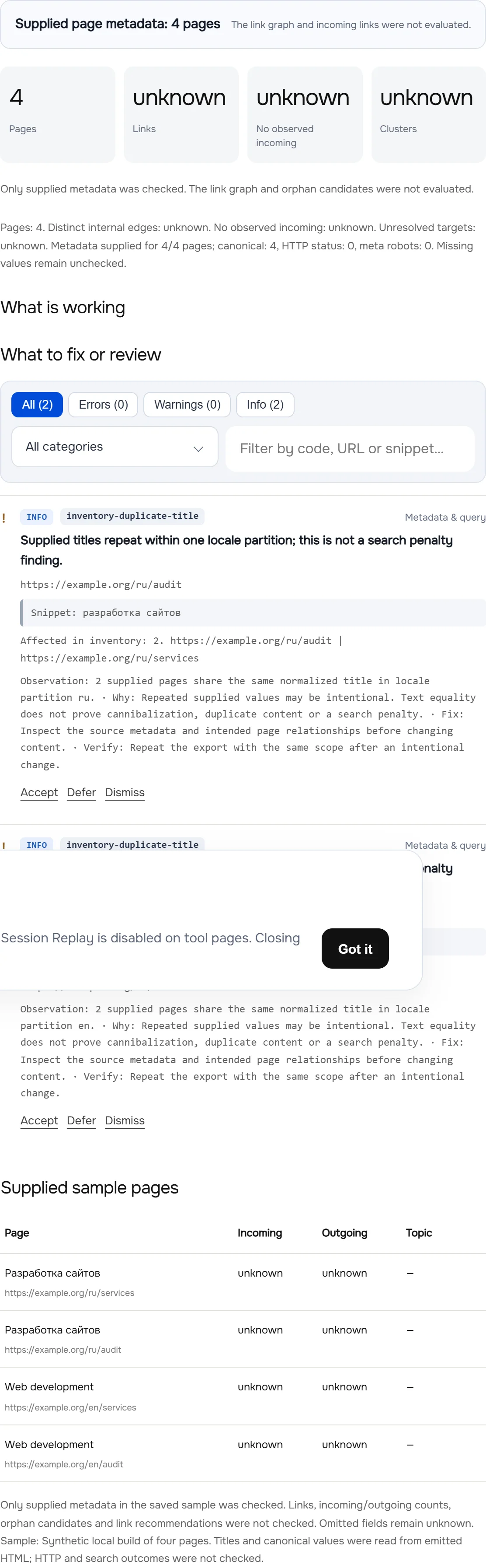
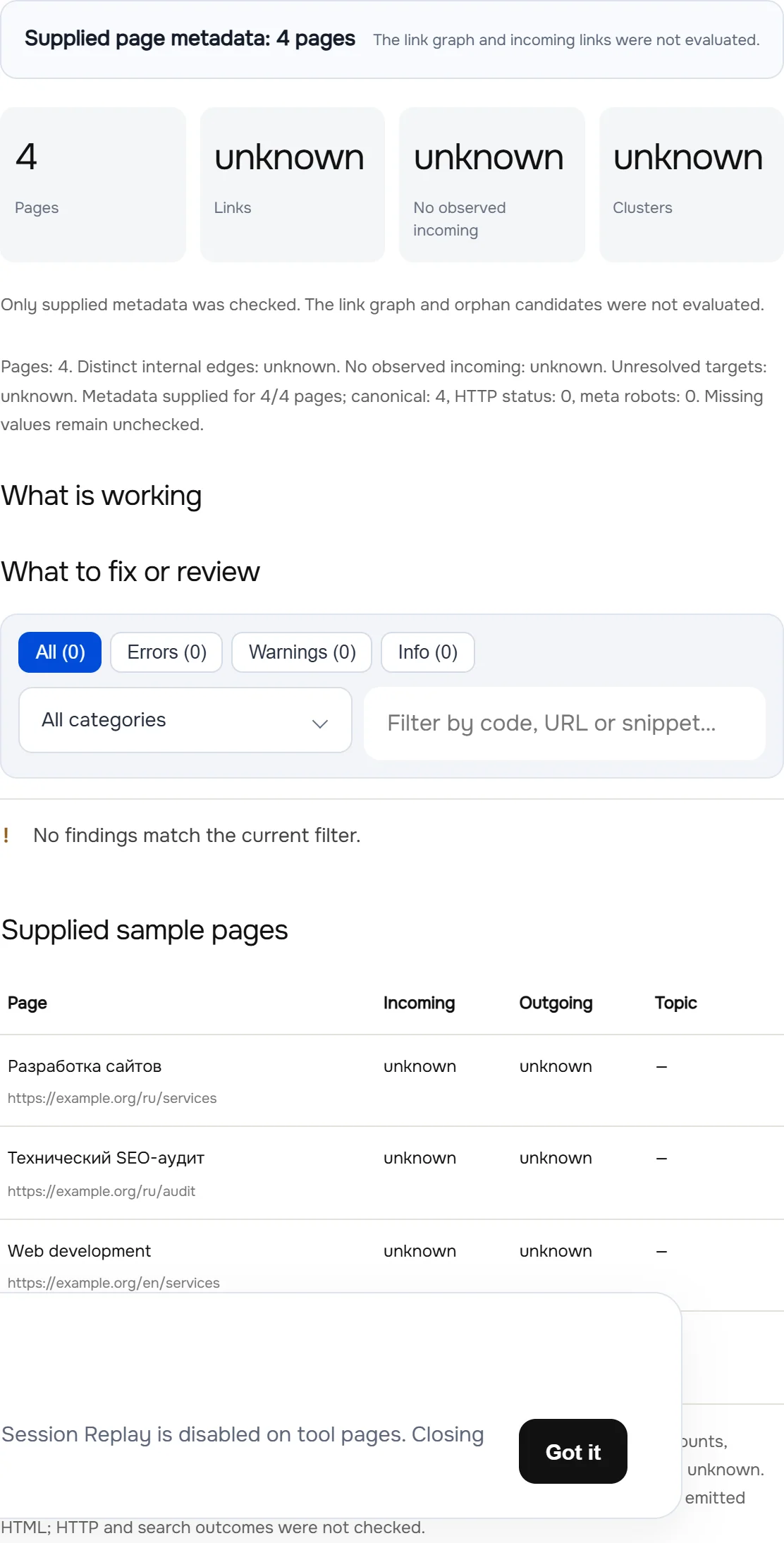
We ran both builds and read the title values from four emitted HTML files in each version. Two audit-page titles changed; the services titles and all four H1 headings stayed unchanged. The inventories were checked with both the CLI and public Reproleaf interface.
| Observation | Before | After |
|---|---|---|
| Files in each inventory | 4 | 4 |
| Duplicate-title groups across the complete inventory | 2 | 0 |
| RU audit-page title | Разработка сайтов | Технический SEO-аудит |
| EN audit-page title | Web development | Technical SEO audit |
| Both services titles and all H1 headings | Original values | Unchanged |
This is an executed source change and output check in a synthetic local project. Nothing was deployed to example.org. HTTP responses, indexing and the displayed search title were not measured.
Recheck the same condition and separate it from search outcome
TIT-01 is accepted when the same four pages remain in scope, the audit titles match their language and purpose, and both services titles and all H1 headings remain unchanged. The repeated report must no longer contain the two earlier groups. Comparing the saved reports confirmed two resolved observations and zero unverified findings.
Reproduce the analysis in Reproleaf: select Site inventory and analyze the original and updated JSON files from this article in sequence. Save both reports. A local installation can compare them with:
node /path/to/reproleaf/src/cli.mjs compare --before before-report.json --after after-report.jsonWe also tested incomplete coverage by retaining only the two services pages. That input has zero duplicate groups, but the comparison retains two unverified findings and confirms zero fixes. Missing pages cannot supply positive correction evidence.
After a real release, inspect freshly served HTML or the agreed rendered state. This example verifies only a local build and supplied metadata. The Reproleaf methodology explains the limits of the comparison.
Estimate effort without pretending to know SEO impact
Effort and SEO impact are different questions. Estimate the work by dependency, regression surface, and the amount of code that must change, not by how important the issue feels. A duplicate-title fix on a shared generator might be simple in code but broad in regression risk because one mapping change can affect multiple locales or templates. Conversely, a visible issue on one page may have a narrow implementation footprint.
| Estimate factor | What to ask | Why it matters |
|---|---|---|
| Dependency | Does the fix require only a mapping change, or a wider template refactor? | Defines how many files may change |
| Regression scope | Which templates, locales, or page types must be rechecked? | Prevents hidden side effects |
| Data gaps | What is unknown about live rendering, crawl state, or downstream signals? | Stops fake certainty |
| Rollout need | Is a staged release, feature flag, or backup path available? | Changes the implementation plan |
Be honest when the estimate is not yet stable. Unknown effort is not the same as urgency. A report can be complete even when it does not support a numeric forecast. That is especially true when the source data is synthetic, the fixture is local, or the live behavior is outside scope. If a team wants more certainty, the answer is more evidence, not a bigger number.
Release the fix with ownership, backup, and rollback defined
Rollout is the point where implementation becomes operational. Before release, confirm the owner, the backup version, the rollback trigger, and the post-release capture plan. The rollback should be limited to the code change you own, not a blind overwrite of unrelated data. That matters when the bug is in a shared generator, because the fix may affect more than one output class even if only one page type was validated first.
A practical release checklist is simple: review the diff, confirm the output fixture, capture the before and after artifacts, publish the code change, and schedule the recheck. If the change is behind a deployment step, make sure the step is recorded in the handoff. If the team needs a template for the work item, use the filled developer task and keep the acceptance criteria attached to the ticket.
For teams outsourcing this kind of work, usefulness comes from clarity, not scale. External help is most useful when you already know the scope, can provide the fixture, and need a clean implementation path or a second set of eyes on the regression risk. Internal teams benefit from the same structure.
FAQ on SEO audit implementation work
Why is an export better than “done” language?
A structured export shows what was checked and what changed. It is easier to verify than a general statement that the work is complete.
Who should implement the fix?
The owner of the shared generator or template should implement it. If the issue touches multiple page types, one person still needs to own the source change.
When is a recheck not enough?
When the rerun is narrower than the original finding, when the data source changed, or when live behavior was outside scope. Then you have a useful check, but not full proof.
Why do bulk template changes need regressions?
Because one mapping or template edit can affect several locales or page groups. A fix that looks small in code can still create side effects in output.
When is outsourcing useful?
When the team needs a fast audit-to-implementation handoff, a repeatable local check, or help separating source changes from report language. It is most useful when the scope and fixtures are already clear.
Next step: send the task, scope, and affected templates
If you want this process applied to your site, send the URL, the exact task, and the affected templates or page groups. Do not send passwords in the first message. If you already have a validated finding, include the source files, the repeat condition, and the expected behavior so the work can be scoped as one implementation task rather than a new audit.
For related reading, use the service overview, the acceptance guide, the duplicate-title grouping example, and the methodology page linked above. The practical goal is the same every time: turn a verified finding into a safe code change, verify the same condition again, and keep implementation separate from promises about rankings or traffic.
When an audit flags a JSON-LD parsing error, use the production acceptance checks in How to fix unparsable structured data in Google Search Console.
Need help with your website?
Development and SEO services →