- Review an existing website or another team’s delivery.
- Implement fixes in WordPress, React, Vue, Astro, and other stacks after project review.
- Document what changed, how it was checked, and which tasks remain.
When this service is the right fit
Use this service when the site already exists, or a launch is approaching, and you need technical decisions tied to real implementation. The common trigger is not “we need more SEO content.” It is more concrete: the site is delivered, but something about crawlability, duplicates, metadata, canonical behavior, page templates, or release hygiene needs a technical owner.
- You received a website from a developer or agency and need acceptance before taking it over.
- You have an SEO report, but no one is actually implementing the fixes.
- Your site is built on WordPress, React, Next.js, Vue, Nuxt, Astro, or a custom stack, and the fix requires code, template, or release work.
- You need a single person to assess, change, and recheck instead of coordinating separate specialists.
This is not a promise to solve everything without review. A real fix depends on access, the current codebase, and what can be changed safely. Public HTML acceptance can be checked quickly; backend logic, business processes, and release approval are separate concerns. That distinction matters because a site can look acceptable in the browser while still depending on hidden systems you have not opened up for review.
The same distinction applies to indexing and traffic. A page can have the right public signals and still not get the search outcome you hoped for. Acceptance is about the technical state you can verify; search performance is influenced by many additional factors outside a simple acceptance pass.
The author page contains my development background and project examples.
What is in scope and what is not
The right scope protects both the buyer and the technical owner. A useful acceptance task should state what is checked, what is changed, and what cannot be promised without deeper access.
| Scope item | Typical problem | Deliverable | Acceptance result |
|---|---|---|---|
| Public HTML | Missing or duplicated title, H1, description, canonical, robots meta | Inventory and notes | Verified by source and recheck |
| Metadata and canonicals | Conflicting signals or chain-like declarations | Fix recommendations or direct changes | Declared state confirmed after update |
| Technical indexing signals | Noindex, blocked templates, inconsistent URLs | Triage with priority | Checked against live pages |
| Implementation | Template, CMS, or code change needed | Source change diff and notes | Rechecked on staging or production |
| Unseen backend | Auth, APIs, data layer, business logic, server config | Marked as unverified or out of scope | Requires access or separate owner |
What is not in scope by default: hidden database rows, private user analytics, payment behavior, or infrastructure details that you do not want exposed. The service should not ask for secrets in public forms. Access should be minimal and revocable, and the owner should control permissions.
If an old contractor handed over the project poorly, that is a handoff problem, not an automatic legal conclusion. The practical answer is to document current access, mark what can be verified, and decide whether the site can be accepted now or needs a controlled follow-up. That is operational guidance, not legal advice.
For report-only work, see the SEO audit deliverables guide. For implementation workflow, use the fix implementation guide.
Discuss the task and implementation scope through the technical SEO service.
How the workflow differs by stack
The public acceptance logic is similar across platforms, but the implementation path is not. The browser output tells you what the site currently exposes; the source and deployment mechanics determine how a fix is applied.
| Stack | What you can usually inspect | Implementation requirement | Notes |
|---|---|---|---|
| WordPress | Rendered HTML, theme output, plugins, canonical behavior | Theme, plugin, or CMS setting change | Often straightforward to recheck after deploy |
| React / Next.js | Rendered metadata, routing, server-side or client-side output | Component, route, or build configuration change | Need awareness of how metadata is generated |
| Vue / Nuxt | Page output, head tags, route behavior | Template or app-level change | Check production and staging separately if both exist |
| Astro | Static page output and build-generated markup | Template or content pipeline change | Good for reproducible source-to-output checks |
| Custom stack / Three.js / mixed stack | Public HTML and route behavior | Depends on repository and deployment process | More review is needed before quoting a fix plan |
On the buyer side, this means your quote should depend on actual stack review, not on a generic package name. On the implementation side, it means you should not promise to fix unknown legacy code without seeing the repository or environment first.
Example deliverable: finding, fix, and recheck
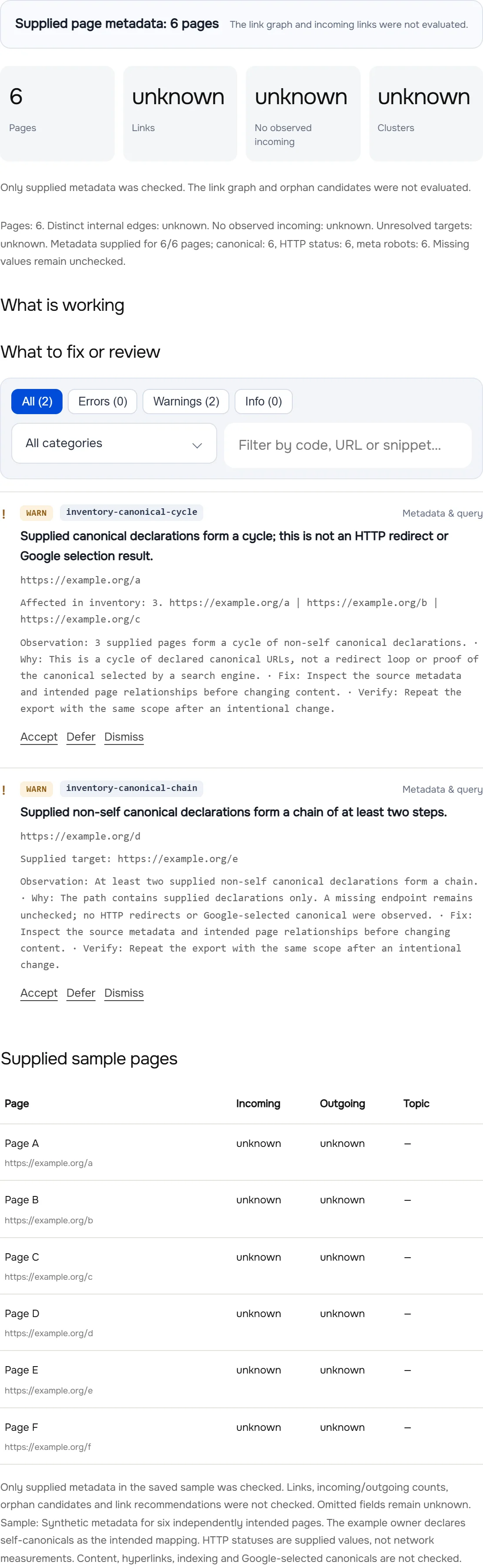
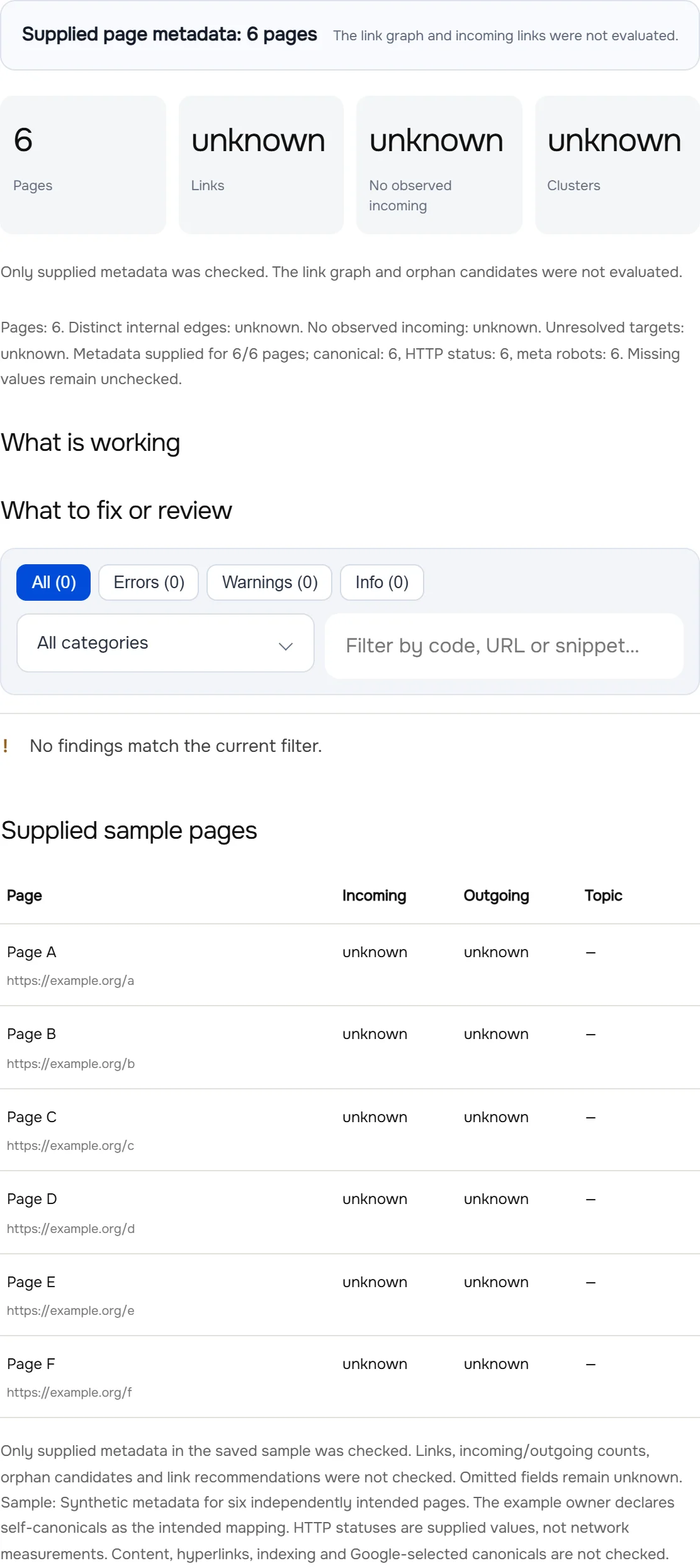
Reproleaf found one canonical cycle and one chain source in a six-page educational inventory. After the metadata change, the repeated report showed zero cycles and zero chain sources. The URL set and check scope stayed the same. The retained input files make this acceptance example reproducible.
The screenshots show actual tool output. Metadata and HTTP statuses are supplied in the educational JSON; this example does not measure a network crawl, internal links, or indexing. The canonical audit guide explains the full example.
Google describes canonical declarations as a preferred-URL signal in its canonical URL guidance. Checking the declaration and observing Google’s selection are separate tasks.
Educational input before the change (JSON)
Reproleaf before report (JSON)
What the implementation workflow looks like
A proper technical SEO acceptance workflow is not a one-line verdict. It is a sequence that reduces ambiguity.
- Accept scope. Define the pages, templates, languages, and business constraints to be checked.
- Collect evidence. Record the live public HTML, screenshots, and source observations that show the current state.
- Triage. Separate issues that can be fixed immediately from issues that require design, CMS, or backend decisions.
- Make code changes. Update templates, routing, metadata generation, canonical logic, or related site settings where access allows.
- Build or stage. Verify the change in the target environment before release when possible.
- Fresh production recheck. Confirm the public output again after deployment.
- Ongoing review if agreed. Continue monitoring only if the project scope includes it.
This workflow is what turns an audit into a real fix. If the client wants only a report, the outcome is limited to findings and recommendations. If the client wants implementation, the outcome should include the source change, proof before and after, test notes, and a clear list of what remains unverified.
That is also why I can position this work as a single technical owner approach. I can inspect public output, change the code where access exists, and then recheck the same pages. I restored evolkov.tech after the old VPS became inaccessible and kept the domain, paths, and languages in place. On 17 November 2026, I ran a smoke check over 125 sitemap URLs: all 125 returned 200, all had self-declared canonical tags, one H1, and no HTML meta-noindex was present. This is an observed 125-URL snapshot, not a whole-domain SEO certification and not proof of perfect rankings or traffic. A compact dated receipt is available in Markdown, and the report reflects real local testing on supplied HTML metadata.
That first-hand result matters because it shows the difference between a report writer and an implementer. The same person can review the acceptance criteria, make the changes, and verify the public result. That is especially useful when you need continuity during a handoff.
The SEO implementation guide explains task handoff, source changes, and repeat checks.
What the client receives at the end
The final package should make handoff easy for the site owner and useful for the next person who maintains the site. A good acceptance result is not only a green checkmark.
- Source change diff or a clear record of what changed.
- Proof before and after with screenshots or captured HTML evidence.
- Test notes explaining what was checked and how.
- What remains unverified so no one confuses a public check with hidden systems.
- Site owner account handling that keeps credentials and permissions under the owner’s control.
- Release and recovery notes so rollback is possible if a change needs to be reversed.
- Documented ongoing plan if the work continues after acceptance.
That list is more useful than a vague “SEO done” statement. It protects the business, because it separates the deliverable from the assumption that every issue is solved forever. It also makes it easier to review another contractor’s handover later, because the evidence is already organized.
For report formatting and scope boundaries, the deliverables guide is the right reference. For implementation and recheck logic, use the implementation guide.
During the evolkov.tech move on 17 November 2026, I checked 125 sitemap URLs. All returned HTTP 200, contained one H1 and a nonempty title, declared a self-canonical, and had no HTML meta noindex. This is a dated snapshot of those URLs, rather than a measurement of rankings, traffic, or Google-selected canonicals. The downloadable acceptance template includes the receipt summary.
The Reproleaf methodology explains data sources and check scope.
Scope, acceptance template, and observed receipt (Markdown)
Same six pages after the change (JSON)
How audit and implementation work is estimated
I do not publish fake prices or hourly promises here, because the real effort depends on the site and the scope. A useful quote comes from review, not from a generic package label.
| Estimate factor | Why it matters | What I need to review |
|---|---|---|
| Number of templates or pages | More surface area means more checks and more possible fix points | Page inventory or sitemap sample |
| Stack and deployment path | Implementation effort depends on how changes ship | Framework, CMS, repository, staging process |
| Current technical state | Duplicates, canonicals, metadata, or release issues change the task size | Live URL samples or report history |
| Access level | Limited access can slow or prevent direct fixes | What can be granted and for how long |
| Verification depth | Simple acceptance is faster than a fix-and-recheck cycle with documentation | Desired output format |
The right questions before quoting are practical: What is the aim, what pages are in scope, which stack is used, who owns deployment, and do you need a report, implementation, or both? If another agency already audited the site, I can review that material first and work from it, but I still need to inspect the live site and understand the current environment before I commit to changes.
This is not monthly content buying and not backlink selling. It is technical work tied to website behavior. If you only need a report, that is one kind of engagement. If you need the implementation under the same technical owner, that is a different and more complete one.
FAQ
Is this just another SEO audit report?
No. A report tells you what is wrong. This service is built for owners who need the fixes implemented and then rechecked, or who need a site accepted after development.
Can you work from another agency’s audit?
Yes, if the report is useful and the live site can be inspected. I can review the existing findings and then decide what can be implemented from the current environment.
What stacks do you work with?
Common examples include WordPress, React, Next.js, Vue, Nuxt, Astro, and custom stacks. The acceptance logic is similar, but the implementation route depends on the repository and deployment setup.
How is price determined?
By scope, stack, access, and the amount of implementation and recheck work. I do not publish fake fixed prices in this article.
What permissions do you need?
Minimal access that can be revoked later: enough to inspect the site, make approved changes, and verify the result. No secrets should be shared through public forms.
What is not guaranteed?
Search rankings, traffic, or Google’s final indexing choice are not guaranteed. A declared canonical is only a signal, and public acceptance does not control every search outcome.
Do you offer continuous support?
Yes, if agreed as an ongoing rhythm after the initial acceptance or implementation pass. That is optional and should be documented clearly.
If your main question is about report structure, the deliverables guide is the right starting point. If your main question is about fixing the site, the implementation guide is more relevant.
Next step
To discuss technical SEO acceptance and website fixes, send the URL, known stack, goal, and preferred timeframe. If an audit or handover issue list already exists, share it without passwords or personal data. These inputs help define access, implementation scope, and acceptance conditions.
For an initial self-check, start with free Reproleaf and the example supplied here.
When accepting a new cover, verify the raw metadata and image URL as shown in How to change the Open Graph image in WordPress and verify it.
Need help with your website?
Development and SEO services →