- Ask for a scope map before asking for a price.
- Separate implementation, licensing, hosting, migration, and support.
- Check how permissions, audit logs, backups, and restore procedures will work.
- Use acceptance criteria that cover data import, role logic, and integrations, not only the login screen.
Build vs buy: how to decide
Compare two separate decisions. Ready-made versus custom describes how the software is obtained and changed. Cloud versus self-hosted describes where it runs and who operates it. A ready-made product may offer self-hosted deployment, while custom software may run on managed cloud infrastructure.
| Decision factor | Check in a ready-made product | Specify for a custom project |
|---|---|---|
| Processes and reporting | Required settings, extensions, data exports, and report definitions | Rules, exceptions, input data, calculations, and expected results |
| Permissions | Required visibility and edit restrictions on the selected plan | A role matrix and tests of allowed and forbidden actions |
| Integrations | Supported operations, connectors, API access, and usage limits | Data mapping, retries, reconciliation, and support responsibility |
| Launch | Configuration, migration, access, testing, and training tasks | Discovery, implementation, migration, testing, and training tasks |
| Operating cost | Licenses, hosting where applicable, connectors, administration, and changes | Infrastructure, third-party licenses, maintenance, support, and changes |
Write down what the system must do and test the candidate product against that list. Ownership and portability also depend on contracts, licenses, source access, documentation, and data export. No software category alone guarantees lower cost, faster delivery, or independence from suppliers.
License examples: what the billing unit means
Checked against official pages on 17 November 2026:
- Pipedrive Lite displayed EUR 14 per seat per month with annual billing: EUR 168 per seat per year, excluding VAT. Five seats therefore cost EUR 840 a year for the license alone.
- Zoho CRM Free lists a free edition for up to three users.
These editions are not assumed to provide equivalent features. The EUR example explains billing rather than providing a US quote: request terms for your billing country and check required functions. Price configuration, migration, integrations, and support separately. Do not combine these license amounts with the hypothetical RUB custom-build model below or use them to claim payback.
Test the middle path before a full build
Compare configuration, an extension, and a separate integration module. Illustrative task: a website lead creates a deal, a separate service calculates a price, and the result returns to an agreed CRM field. Acceptance conditions: one submission creates one deal; retrying creates no duplicate; calculation failures remain visible and can be retried; only an authorised role sees the amount. Check the required API operations and plan access. Quote a whole new CRM if the remaining requirements cannot reasonably be met by the selected approach. This is a task example, not a delivered client result.
What custom CRM development actually includes
Before you request a quote, define the scope in business language. A CRM project is usually a combination of process design, data design, interface work, integrations, and acceptance support. The exact mix changes the estimate more than the number of users alone.
| Module or constraint | What it usually covers | Why it affects cost |
|---|---|---|
| Process mapping | Stages, statuses, transitions, exceptions | Every unique rule becomes part of the build and testing work. |
| Permissions and access control | Roles, field visibility, edit rights, approvals | Fine-grained access logic takes time to design and verify. |
| Audit trail | Who changed what and when | Useful for accountability, compliance, and troubleshooting. |
| Backups and restore | Backup schedule, recovery procedure, restore testing | Operational safety is part of delivery, not an optional extra. |
| APIs and integrations | ERP, accounting, telephony, email, messaging, marketplaces | Each connector adds mapping, error handling, and support effort. |
| Data migration | Import mapping, deduplication, field conversion | Old data rarely fits the new structure without cleanup. |
| Documentation and handover | Admin docs, user guidance, source access terms | Without handover materials, the system becomes harder to maintain. |
Do not ask for “a CRM” as a single thing. Ask for a model of processes, permissions, data, integrations, and acceptance conditions. That is what turns a vague request into a quote you can audit.
How the estimate changes
Custom CRM development cost is driven more by complexity than by seat count alone. The main drivers are the amount of business logic, the number and difficulty of integrations, and the depth of permission design. If a ready-made CRM needs heavy workarounds or repeated add-ons, the total cost can rise quickly.
| Estimate factor | Lower-cost version | Higher-cost version | Effect on quote |
|---|---|---|---|
| Business logic | Simple pipeline, few rules | Many stages, exceptions, calculations | More logic means more development and testing. |
| Integrations | Single API or basic sync | Multiple systems, bidirectional sync, edge cases | Integration work often needs separate analysis and buffer time. |
| Permissions | Simple roles | Granular field-level control | Detailed access rules are costly to design correctly. |
| Data migration | Clean export/import | Messy legacy data, custom fields, duplicates | Mapping and cleanup add effort before go-live. |
| Acceptance scope | Basic UI checks | Role tests, import tests, restore tests, integration tests | Broader acceptance reduces post-launch surprises, but it adds project work. |
Important exclusions should be stated up front: taxes, third-party licensing or usage fees, staff time on the client side, and future change requests are budget items of their own unless the quote explicitly includes them. Scheduled maintenance after launch should also be separate from the initial build.
Worksheet inputs for a three-year scenario
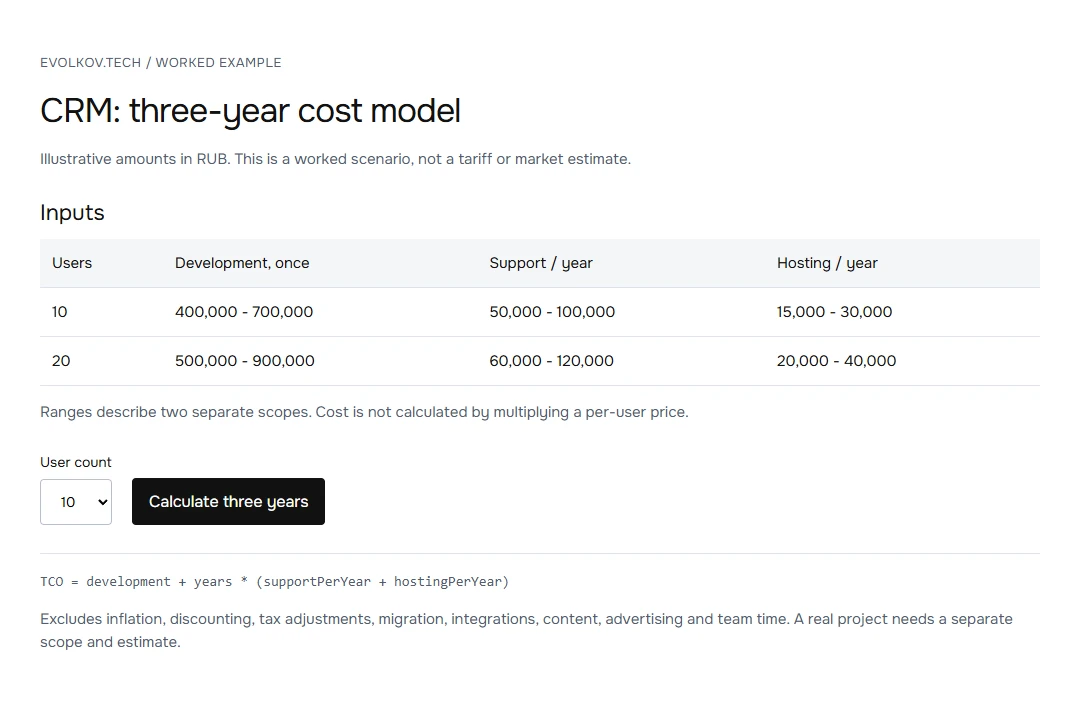
The next two sections show an illustrative cost worksheet prepared for this article on 17 November 2026. All amounts are hypothetical RUB inputs, not US-market estimates, vendor tariffs, or a quote. Scenarios A and B have separate scope assumptions; they are not a per-seat pricing schedule. For another market, enter consistent local cost estimates and retain one currency throughout.
Figure 1 represents the worksheet input view used for the model below.
| Scenario label | Users | Development input | Annual support | Annual hosting |
|---|---|---|---|---|
| A | 10 | 400,000–700,000 RUB | 50,000–100,000 RUB | 15,000–30,000 RUB |
| B | 20 | 500,000–900,000 RUB | 60,000–120,000 RUB | 20,000–40,000 RUB |
To make an estimate usable, specify these input categories before asking for a quote:
- How many processes will be modeled in the first release.
- Which roles need access and what each role may see or change.
- Which external systems must exchange data with the CRM.
- What data must be migrated, cleaned, or mapped manually.
- What acceptance tests must pass before go-live.
This worksheet prices only the two custom-build scenarios. It contains no priced ready-made alternative, so it cannot establish a build-or-buy saving. To make that comparison, obtain a separate quote and include the same functions, period, setup, data work, licenses, and operating responsibilities.
Three-year workbook results
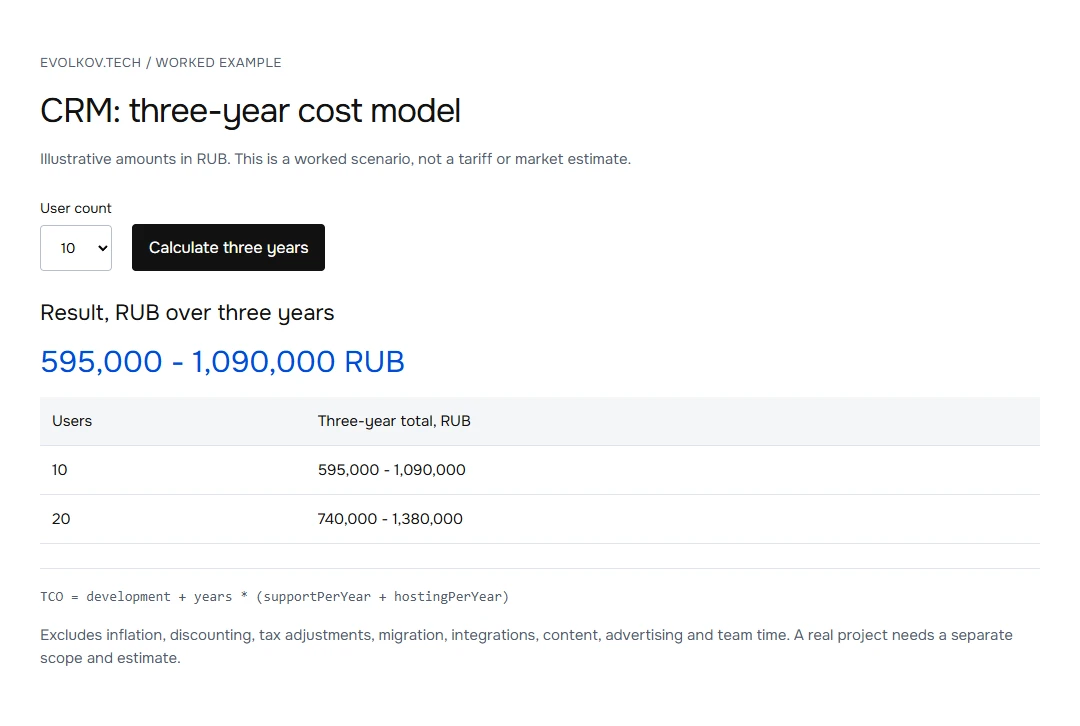
The formula for each bound is: one-off development + 3 × annual support + 3 × annual hosting. Figure 2 is an actual capture of the local worksheet for these inputs. The worksheet calculations were checked; this is an illustrative calculation, not a client result.
| Scenario | Users | One-off development | Annual support | Annual hosting | Three-year modelled cost |
|---|---|---|---|---|---|
| A | 10 | 400,000–700,000 RUB | 50,000–100,000 RUB | 15,000–30,000 RUB | 595,000–1,090,000 RUB |
| B | 20 | 500,000–900,000 RUB | 60,000–120,000 RUB | 20,000–40,000 RUB | 740,000–1,380,000 RUB |
For scenario A, the lower bound is 400,000 + 3 × 50,000 + 3 × 15,000 = 595,000 RUB. The upper bound is 700,000 + 3 × 100,000 + 3 × 30,000 = 1,090,000 RUB. Apply the same formula to scenario B.
The model excludes taxes, inflation, discounting, migration, integrations, training, internal staff time, extra licenses, future changes, and exit costs. Add these lines before treating the result as a complete ownership budget. Support starts in year one in this worksheet; change that input if your quote includes an initial support period.
The figures do not identify a user-count break-even point or show that a custom CRM is cheaper than a ready-made product. They demonstrate how scope inputs and recurring costs affect a three-year estimate. Use a consistently scoped ready-made quote for a separate comparison.
Delivery, files, and public-site verification
For delivery and handover, the next artifact is the model document: crm-en-model.md. The matching input and result files are part of the same package: crm-inputs.json and crm-results.json.
For a CRM project that also publishes public pages, Reproleaf can inspect supported technical facts in captured HTML. It does not test private CRM logic, access control, business formulas, or actual search indexing. The methodology explains those limits.
If the project includes public website changes, use the post-release SEO checks guide for that part of acceptance. Private CRM permissions, import reconciliation, and integration behaviour need their own tests. These are separate verification tasks.
For background on the parent service, see web application development. For the author background, see about the author.
How to accept the project
Acceptance should not be limited to “the interface opens.” A CRM project is accepted when the business rules, data flows, and operating procedures work as agreed. That means you should test the system against the same conditions that made you ask for custom development in the first place.
- Process acceptance: the defined pipeline works from entry to close, including exceptions.
- Permission acceptance: each role sees and edits only what was agreed.
- Integration acceptance: data moves correctly between systems and errors are handled.
- Migration acceptance: imported data matches the mapping and duplicates are resolved by rule.
- Operational acceptance: backups, restore steps, and access handover are documented.
- Support acceptance: who fixes what after launch is written down, including change-request handling.
Do not treat source handover as a vague promise. Agree what source access means, what documentation is included, and who owns the operational knowledge after launch. If the project is likely to evolve, add a release guide and a change-control process so that future updates do not become ad hoc work.
When you are comparing proposals, ask the same questions of every vendor or contractor: what is in scope, what is excluded, what is measured in acceptance, and what will be maintained after go-live?
Agree a small, anonymised acceptance dataset before development. Include a duplicate contact, a record with a missing optional field, an inactive user, and a failed integration request. For each case, record the starting state, action, expected record changes, and expected audit entry. During review, test an allowed action and a forbidden action for each relevant role; a working administrator account does not establish restricted-user behaviour. Reconcile imported record counts and representative field values against the agreed source. Keep the dataset version and observed results with the handover notes so another developer can repeat the checks after a later change.
Use the website acceptance and fixes guide to turn public-site findings into scoped work.
FAQ
How do I know whether custom CRM development is worth it?
Test a ready-made product against the required processes, reports, roles, and integrations. If gaps remain, compare configuration, extensions, and custom implementation with the same scope and operating period.
What should be fixed before I ask for a quote?
Describe the current process, the future process, roles, systems to integrate, data to migrate, and the acceptance rules. A quote without that is only a rough guess.
Does a custom CRM automatically mean lower long-term cost?
No. Compare actual implementation and operating costs on the same assumptions. Replacing manual work or paid add-ons may change the result, but any saving requires priced inputs and a defined period.
Can we move data from an existing CRM?
Usually yes, but not everything transfers cleanly. Core entities such as contacts, companies, and deals are often portable; custom fields, special widgets, and some history items may require manual mapping or compromises.
What should be in the acceptance checklist?
Test roles, permissions, audit logs, import mapping, integrations, backups, restore procedure, and the main workflows. The UI is only one part of acceptance.
How do I avoid being locked into a dead-end build?
Ask for documentation, source access terms, a maintenance plan, and a change process. A custom system still needs support, and support needs a handover structure.
Next step
If you need a custom CRM development cost estimate for your own process, the most useful next step is a short requirements brief: current workflow, planned workflow, number of roles, required integrations, data to migrate, and any permission constraints. With that, the quote becomes comparable instead of generic.
Start with the parent service page here: web application development. If you want the estimation to be tied to a real implementation path, include your process map and your acceptance checklist in the first message.
When the next task is not a CRM but a broader product release, use the same discipline: scope first, estimate second, acceptance third. Record the agreed scope and acceptance conditions so later change requests can be evaluated against them.
Worked guide: CRM requirements template. Inputs, check limits and downloadable JSON results.
Worked guide: CRM data migration checklist. Inputs, check limits and downloadable JSON results.
Estimate cleanup separately once you know the matching and review rules. See How to deduplicate CRM contacts without merging different people.
Before signing off on a custom CRM build, run a real sales workflow in staging. Start with CRM UAT testing: 8 sales workflows to verify before launch.
Once the system is live, add CRM data quality after launch: five checks to run on an export to the maintenance plan.
Need help with your website?
Development and SEO services →